And why the product-minded engineer is the only role that survives intact.
Product managers. Project managers. Engineers. Three roles, three headcounts, three calendars full of alignment meetings — and in the age of AI-assisted development, an increasingly hard structure to justify.
Here's the uncomfortable truth the industry doesn't want to hear: the product-minded engineer is the only role that survives the AI era intact. At uRadical, we've already made this bet — and we're helping our clients do the same.
The Old World Made Sense (Once)
The traditional split existed for a reason. When shipping software meant months of coordinated effort across large teams, you needed someone to figure outwhatto build (product manager), someone to keep the trains running (project manager), and someone to actually build it (engineer). Each role required deep specialisation, and the interfaces between them — PRDs, Jira tickets, standups, retros — were the cost of doing business.
But that model was designed for a world where the bottleneck was engineering throughput. Writing code was slow, expensive, and required absolute focus. You couldn't reasonably expect the person deep in a concurrent data pipeline to also be thinking about churn metrics and user onboarding flows.
That world is disappearing fast.
The Numbers Tell the Story
The data on how engineers actually spend their time is striking — and it reveals why the old role boundaries are ripe for collapse.

According to an IDC report published in early 2025, developers spend only 16% of their time on application development. The rest goes to operational tasks, security, CI/CD, monitoring, and everything else that isn't writing code. Atlassian's 2025 State of Developer Experience survey paints an even starker picture: 50% of developers report losing 10+ hours per week to non-coding tasks, and 90% lose 6 or more hours, largely due to organisational inefficiencies — not technical ones.
Meanwhile, Software.com's Code Time Report, based on data from 250,000+ developers, found that the average developer actively writes code for just 52 minutes per day. That's less than an hour of actual coding in an eight-hour workday.
So what are engineers doing with the other seven hours? Meetings. Slack. Jira. Waiting for approvals. Context switching. Translating product requirements. Aligning with PMs. Updating stakeholders. The organisational machinery that exists precisely because we've split product thinking from technical execution into separate roles.
Here's the critical insight: AI coding tools don't just speed up the 52 minutes of coding. They compress it so dramatically that the other seven hours become the real opportunity for transformation.
What AI Actually Changes
The AI productivity data is maturing fast, and the picture is nuanced but directional.

The 2025 Stack Overflow Developer Survey reports that 84% of developers are using or planning to use AI tools, up from 76% the prior year. 51% of professional developers now use AI tools daily. JetBrains' 2025 Developer Ecosystem survey, covering over 24,000 developers, found that 85% regularly use AI tools for coding, with nearly nine out of ten saving at least an hour per week, and one in five saving eight or more hours — the equivalent of an entire working day.
On the output side, 41% of all code written in 2025 is now AI-generated or AI-assisted. Google's CEO Sundar Pichai has stated that 25% of Google's code is AI-assisted. GitHub Copilot users report completing 126% more projects per week than those coding manually.
But here's where it gets interesting. A rigorous randomised controlled trial by METR, published in July 2025, found that experienced open-source developers actually took 19% longer on tasks when using AI tools — despite believing they were 20% faster. The extra time came from reviewing, debugging, and correcting AI-generated code.

This isn't a contradiction. It's the whole point.
AI doesn't eliminate the need for engineering skill — it shifts where that skill matters. The mechanical act of typing code is being automated. What remains — and what AI makesmoreimportant — is the ability to design systems, evaluate trade-offs, review output critically, and make judgment calls about what to build and why. These are precisely the skills that sit at the intersection of product thinking and technical architecture.
When you can describe an architecture to an agent and have it produce a working implementation in minutes rather than days, the bottleneck moves from "can we build this?" to "should we build this, and have we designed it correctly?"
And if that sounds like a product manager's job description crossed with an architect's, that's exactly the point.
The Great Role Convergence Is Already Happening
This isn't a theoretical prediction. The industry is already moving.
Airbnb's restructure was the opening salvo. In 2023, CEO Brian Chesky announced that Airbnb had "gotten rid of the classic product management function," merging PM with product marketing and elevating designers to equal partners with engineers. Chesky's rationale was blunt: too many layers between strategy and execution create a game of telephone. Research backs this up — studies suggest that as few as 7% of employees can articulate their company's strategic initiatives.
Shopify's AI-first mandate took it further. In April 2025, CEO Tobi Lütke sent a company-wide memo declaring that "reflexive AI usage is now a baseline expectation at Shopify." The headline policy: teams must now prove why AI can't handle a task before requesting additional headcount. Lütke reported that employees leveraging AI have achieved "100X the work" on previously implausible tasks. AI competency is now formally part of Shopify's performance reviews.
Microsoft's May 2025 layoffs hit product management hard — 373 PM roles cut from Redmond alone, alongside 817 software engineering roles, as the company explicitly focused on "reducing managers." This wasn't a cost-cutting exercise in a struggling company; it came weeks after Microsoft reported sales and profits that beat expectations.

The pattern is clear: companies are cutting coordination roles and betting on fewer, more capable people augmented by AI.
The Uncomfortable Middle: Where PMs and PjMs Both Get Squeezed
Let's be direct about what happens to traditional product managers and project managers in this new world.
The project manager faces the most obvious problem. When one product-minded engineer with AI tooling can do the work that previously required a team of three or four, there's simply less to coordinate. The project manager is reduced to managing a person who is managing an agent — overhead on top of overhead.
The product manager faces a subtler but equally existential challenge. A PM who can't engage with system design and technical trade-offs becomes an intermediary between the customer's problem and the technical solution — writing requirements documents that an engineer then translates into prompts and architectural decisions. Every handoff is a lossy compression. The PM understands the user's pain but can't evaluate whether the proposed technical approach actually addresses it well. The engineer understands the constraints but has to rely on the PM's interpretation of what the user needs. Two people, both holding half the picture, burning cycles on alignment.
Both roles end up in the same place: a layer of indirection between the problem and the solution.
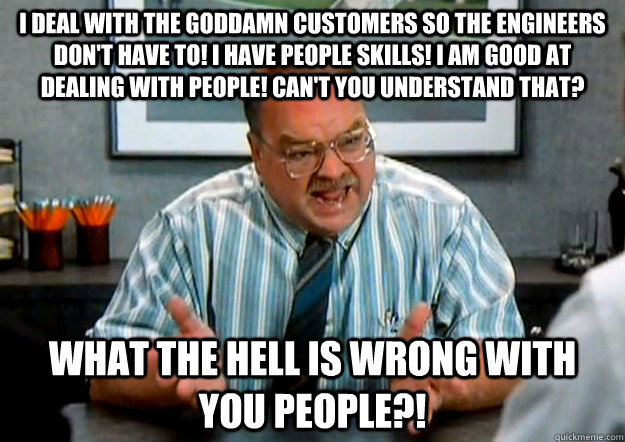
Tom Smykowski, Office Space (1999) — inadvertently making the case for product-minded engineers since before it was a job title.
A single product-minded engineer holding the full picture? They can talk to a customer, understand the problem, sketch an architecture, guide an agent to implement it, and evaluate whether the result actually solves what it needed to solve. No handoff. No lossy translation. No alignment meeting.
The developer-to-PM ratio tells the story of where this is headed. Andrew Ng has suggested the ratio could soon flip to 2:1 (developers to PMs), compared to the previous norm of 1 PM to every 4–6 engineers. But that framing still assumes the roles remain separate. The more radical — and we'd argue correct — reading is that the ratio collapses entirely for small teams: one product-minded engineer replaces what previously required a PM, a project manager, and two to three additional engineers.
The Rise of the Lean AI-Native Team
The evidence for ultra-lean teams is no longer anecdotal — it's structural.
Midjourney reached an estimated $200 million ARR with just 11 employees. Cursor, the AI code editor, soared to $100 million ARR in under a year with approximately 20 engineers. Sam Altman has publicly predicted the first "one-person billion-dollar company." In 2024, 38% of US startups were founded by solo entrepreneurs, up from 22% in 2015, and an impressive 52.3% of successful startup exits were achieved by solo founders.

These aren't flukes. They represent a structural shift in how much a single technically capable person can achieve when augmented by AI.
The World Economic Forum's 2025 Jobs Report found that 41% of employers expect to downsize their workforce by 2030 due to technology. The companies that thrive won't be the ones that simply cut headcount. They'll be the ones that replace bloated role hierarchies with fewer, more capable people who own problems end-to-end.
What a Product-Minded Engineer Actually Looks Like
This isn't about turning every engineer into a junior PM with commit access. It's about recognising that the most effective people in AI-era software development combine capabilities that were previously spread across three roles:
They understand the problem space. They talk to users. They read support tickets. They grasp the business model. They knowwhysomething matters, not just what's been specified. As Mixpanel Technical Lead Manager Sonya Park puts it: "The crux of being a product engineer is synthesising customer input to create a solution, while still maintaining a good return on investment."
They design systems, not just features. They think in architectures, data flows, and failure modes. They make trade-offs between complexity and capability. They know when to build and when to buy. This is the skill that no PM and no AI agent can replace — the ability to hold a complete system model in your head and reason about its behaviour.
They guide AI effectively. This is the new craft. The METR study showed that experienced developers got slower with AI — not because AI is useless, but because they hadn't yet optimised their workflow around it. The developers who thrive are those who know how to decompose problems, specify constraints, review AI-generated code critically, and iterate toward production-quality solutions. This requiresmoretechnical depth, not less.
They ship and evaluate. They deploy, measure, learn, iterate. They own the outcome end-to-end, not just the implementation. They don't throw code over the wall to a PM to validate — they validate it themselves because they understand both the technical and product dimensions.
The Project Manager Was Already on Borrowed Time
Project management as a standalone role in small-to-medium software teams has been under pressure for years. Agile was supposed to distribute project management across the team. In practice, it often just renamed the project manager to "scrum master" and carried on.
But with AI compressing timelines and reducing team sizes, the coordination overhead that justified a dedicated project manager shrinks dramatically. When one person can do the work that previously required three or four engineers, there's simply less to coordinate. The remaining coordination — prioritisation, stakeholder communication, timeline management — is well within the remit of a competent engineer who understands the product.
JetBrains' 2025 survey data reinforces this: developers themselves highlight that 62% of non-technical factors are critical to their performance — internal collaboration, communication, and clarity. The best engineers are already doing this work. Giving them permission (and the title) to own it formally is the logical next step.
The Counterargument (And Why It's Weakening)
The strongest argument for keeping roles separate is specialisation. A dedicated PM can spend all day on customer research, competitive analysis, and strategic thinking. An engineer splitting time between product thinking and implementation supposedly does both worse.
This was valid when implementation consumed 80% of an engineer's time. But when AI handles increasing portions of implementation — 41% of code is already AI-generated, developers save 30–60% of their time on coding, testing, and documentation tasks — the engineerhasthe time for product thinking. The constraint that forced specialisation is dissolving.
The other argument is that some people are simply better at customer empathy and communication than at technical work (and vice versa). True — but this is an argument for hiring well-rounded people, not for structuring your org around the assumption that these skills can't coexist in one person.
These aren't distractions from the engineering role — they are the engineering role, or at least they should be.
How uRadical Operates (And How We Can Help You Get There)
At uRadical, we didn't arrive at this model through theory. We built it out of necessity and conviction.
Our team operates as product-minded engineers. We don't employ separate product managers or project managers. Every person who works on a client project understands the customer problem, designs the technical solution, guides AI agents through implementation, and owns the outcome. We've built products like MyWelcomeBook.com (a multi-tenant SaaS for guest houses), envctl (a peer-to-peer secrets management tool with post-quantum encryption), and Music Bingo Live — each conceived, architected, and shipped by product engineers, not by committees.
The results speak for themselves: faster delivery, lower costs, and products that actually solve the problem they were designed to solve — because the person building them was never more than zero handoffs from the customer.
We help organisations make this transition. Whether you're a startup that's about to make your first hires, a scale-up drowning in coordination overhead, or an enterprise team that's been told to "do more with less," we can help you:
- Restructure teams around product-minded engineers rather than role-based silos
- Implement AI-augmented workflows that actually deliver on the productivity promise (not just install Copilot and hope)
- Upskill existing engineers to think in product terms — customer empathy, business models, outcome measurement
- Architect systems that are designed for AI-assisted development from the ground up
- Reduce handoff overhead by designing processes where the person closest to the problem is empowered to solve it
We're not selling a framework or a certification. We're a technical partnership. We've done this ourselves, we're doing it right now, and we can help you do it too.
The Bottom Line
The AI era doesn't need more role specialisation. It needs fewer, more capable people who can hold the full picture: customer need, technical architecture, and implementation — all in one head.
Product managers who can't engage technically will find themselves increasingly sidelined — reduced to managing people who are managing agents. Project managers in small teams will find their coordination overhead hard to justify when there's less to coordinate. But engineers who understand their users, who can design systems and guide AI agents to build them, who can own outcomes end-to-end — they'll be more valuable than ever.
The Hydra is dying. Every head you cut — every role you add — just grows two more coordination problems. Stop feeding it. The data confirms the alternative works. The market is pricing it in. The companies that adapt fastest will win.
Long live the product engineer.
uRadical builds products with product-minded engineers. We help organisations navigate the shift from role-based silos to lean, AI-augmented teams that ship faster and closer to the customer. Get in touch to talk about how we can help your team make the transition.
Sources & Further Reading
- Stack Overflow 2025 Developer Survey — 84% AI tool adoption; 51% daily usage among professionals
- JetBrains Developer Ecosystem 2025 (24,534 developers) — 85% regular AI tool usage; 1 in 5 saves 8+ hours/week
- IDC: How Do Software Developers Spend Their Time? (2025, via InfoWorld) — Only 16% of developer time on application development
- Atlassian 2025 State of DevEx Survey (3,500 developers) — 50% lose 10+ hours/week to non-coding tasks
- METR: Measuring AI Impact on Developer Productivity (July 2025, RCT) — Experienced developers 19% slower with AI despite perceiving 20% speedup
- Software.com Code Time Report (250K+ developers) — Developers actively code 52 minutes per day
- MIT Technology Review: AI Coding Is Now Everywhere (Dec 2025) — Developers spend 20–40% of time coding (Bain); 65% use AI weekly
- Microsoft Layoffs: Engineers, Product Managers Cut (Bloomberg/Entrepreneur, May 2025) — 373 PM + 817 eng roles cut from Redmond HQ
- Shopify CEO: Prove AI Can't Do Jobs Before Asking for Headcount (CNBC, April 2025) — AI mandatory; teams must justify hiring
- Airbnb Eliminated the Traditional PM Role — Now What? (LogRocket) — Merged PM with product marketing
- The Next Unicorn Could Be a Solo Entrepreneur with AI (YourStory) — Midjourney $200M ARR / 11 employees; Cursor $100M ARR / ~20 engineers
- WEF Future of Jobs Report 2025 — 41% of employers expect workforce downsizing by 2030
- How Solo Entrepreneurs Use AI to Simulate Full Teams — 38% solo-founded US startups in 2024 (Carta/WSJ); 52.3% of exits by solo founders
- The Dawn of the Product Engineer (Nikhil Sachdeva) — AI reshaping PM roles into product engineers
- Developer Productivity Statistics with AI Tools 2025 (Index.dev) — 41% of code AI-generated; 126% more projects/week with Copilot
- It's Happening: The Consolidation of PM Roles — Instagram TPMs consolidated; industry trend analysis