And Why the Future Belongs to Distributed, AI-Powered Teams
There is a narrative being pushed hard in boardrooms, in business media, and across LinkedIn thought-leader posts: remote work does not work. It kills collaboration. It murders productivity. It is the enemy of culture. The only path forward is the return to office.
This narrative is a lie. Not a complete fabrication, but a carefully constructed half-truth, amplified by people with very specific financial interests in getting bodies back into buildings. The loudest voices calling for a return to the office are not the most credible voices on how to build great companies. They are, disproportionately, the people who own the buildings.
We write this as a remote-first company. uRadical builds distributed systems for clients across time zones. We have onboarded junior developers remotely and had them productive. We run a consultancy from Northern Ireland that serves clients in London and beyond. We are not theorising about whether remote work can succeed. We are doing it, every day, and have been for years.
The Real Problem: Bad Management and the Death of Office Politics
Let us be direct about something most commentary on this topic dances around. Remote work failures are not remote work failures. They are management failures. Every single time.
Four years of post-pandemic research have reached a strikingly clear conclusion: working from home makes people more content, and managers dislike it. Not because it fails, but because it shifts where power and trust live in a company.
In the pre-remote era, office politics played a far greater role than anyone in leadership wanted to admit. Being friendly with the right people mattered. Visibility mattered. The person who stayed late and made sure the boss saw them staying late mattered more than the person who finished their work efficiently and went home. Promotions went to the people who played the game, not necessarily to the people who delivered the most value.
Remote work blew that up. And a lot of people in positions of power are furious about it.
Ask yourself a blunt question: what are we here for? Are we professionals, here to deliver something that matters, to get a sense of achievement and fulfilment from pushing things forward, from making things better? Or are we a bunch of immature keeping-up-with-the-Joneses types, seeking false validation by knowing the right equally phoney people?
Work matters. We live, we die, and in between, work takes up a huge portion of our time. It enables family, it provides balance, it gives us purpose. Working from home swings things in favour of humanity. Meaningful work where you feel secure and confident knowing you are delivering, without the ridiculous commutes to offices, sitting in cars, adding pollution, wasting time that could be spent with your family or your community.
Researchers tracking thousands of workers since the pandemic have consistently found higher life satisfaction among those with remote flexibility. As one analysis put it, employees describe remote work with words like"freedom", "focus", and "breathing space" Managers, by contrast, use sharper language:"control", "culture", "visibility", "slipping standards" When asked about performance, many insist productivity dropped, even in companies where output stayed the same or went up.
Remote work does not just move where we work. It moves where power and trust live in a company. And for leaders whose entire identity was built on physical presence — walking the floor, reading body language in corridors, being the most important person in the room — that is deeply threatening.
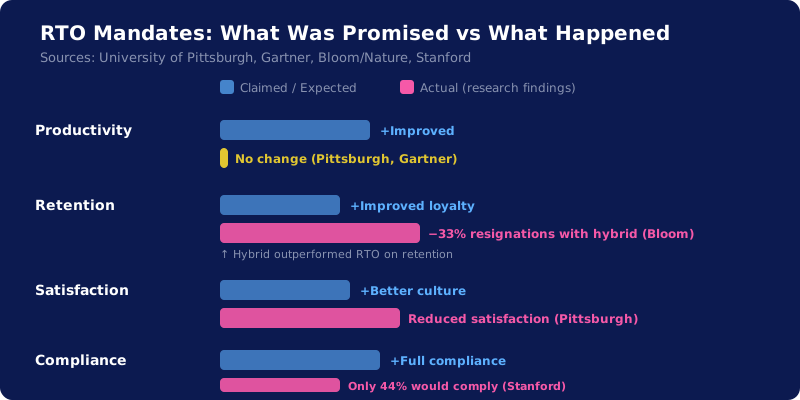
A landmark study from the University of Pittsburgh, examining S&P 500 companies that implemented return-to-office mandates, found that most directives stemmed from control dynamics rather than evidence. RTO mandates hurt employee satisfaction but produced no significant changes in financial performance or firm values. The study's authors stated plainly that managers were using mandates to"reassert control over employees and blame employees as a scapegoat for bad firm performance."
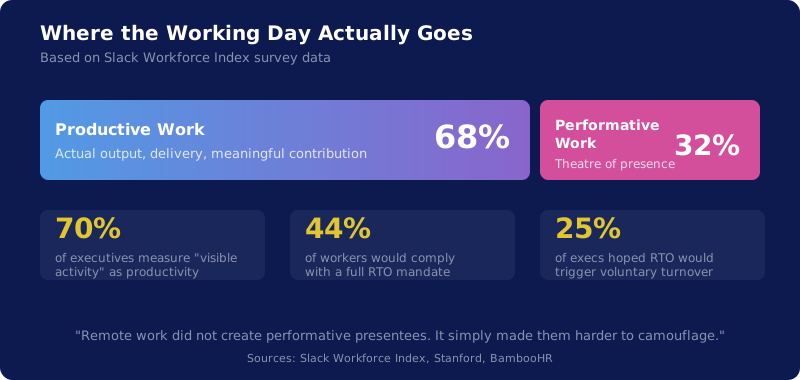
According to a Slack survey, 70% of executives use visible activity as a primary measure of productivity. That same survey found employees spend 32% of their time on performative work that merely gives the appearance of productivity. Nearly a third of the working day spent on theatre.
What We Have Actually Seen: Remote and In-Office Failures Have the Same Root Cause
We have onboarded junior developers into remote teams and had them productive within weeks. This worked because of a clean codebase that was deliberately kept simple and easy to follow. The standard bits had been automated, so new developers were free to focus on the task at hand rather than wrestling with boilerplate. Combined with a good culture of people being approachable, it worked. The right people trump anything else. You can work with them and teach them anything.
The in-office world, by contrast, tends to be set up to cope with the wrong people. Open-plan surveillance. Mandatory desk hours. Layers of process designed not to enable good work but to prevent bad actors from hiding. That is an enormous amount of organisational energy spent on a problem that could be solved more simply: hire the right people and give them clear direction.
Of the failed projects we have seen — both remote and in-office — they failed for the same reasons every time. Poor communication, a lack of focused vision, and leaders who did not lead. By not taking responsibility, those leaders left the door open for negative behaviour to take over the team. The loudest person ended up driving priorities instead of the person with the clearest understanding of the problem. This reduced impact, increased delivery times, and missed opportunity.
Being a leader is hard. Being a remote leader is slightly harder. But a hard truth is that many people in leadership positions show a daily lack of taking responsibility for their teams. This fails eventually in-office too — but arguably it fails faster when people work from home. And that is a pro, not a con. Better to see and find problems early than to let them fester behind the camouflage of office presence. Remote work does not create dysfunction. It surfaces it. If your team falls apart without an office, it was already falling apart. You just could not see it.
Follow the Money: The Property Interests Behind the RTO Push
Remote work has triggered what the American Economic Review, in a peer-reviewed study published in February 2026, called an "Office Real Estate Apocalypse", with $556.8 billion in value destruction across US office markets and a 46% decline in long-run values for New York City office buildings alone.
McKinsey Global Institute projected that across nine global superstar cities, remote work could wipe out up to $800 billion in office property value by 2030. These numbers represent the foundations of pension funds, bank portfolios, and the personal fortunes of commercial real estate investors.
As this article was being finalised, the stock market provided a real-time demonstration of every argument made above. On 12 February 2026, commercial real estate stocks suffered their worst sell-off since the Covid crash. CBRE — the world's largest commercial real estate services firm — plunged nearly 13% intraday, a magnitude of decline only previously seen during the pandemic and the 2008 global financial crisis. Jones Lang LaSalle dropped 12%. Cushman & Wakefield fell 14%. The trigger was not a sudden change in office vacancy rates or a collapse in lease renewals. It was something far more fundamental: investors rotating out of what Keefe, Bruyette & Woods analyst Jade Rahmani described as "high-fee, labour-intensive business models viewed as potentially vulnerable to AI-driven disruption."
The irony is telling. CBRE had just reported an earnings beat and issued strong full-year guidance. Its CEO insisted the company's core businesses would not be disrupted by AI. The market disagreed. When the people whose job it is to allocate capital looked at the intersection of remote work, AI, and commercial real estate, they saw a sector in structural decline — regardless of what one quarter's earnings said. The $556.8 billion in value destruction documented by the American Economic Review is not a theoretical projection. It is being priced in, in real time, by the same financial system that the return-to-office lobby claims to serve.
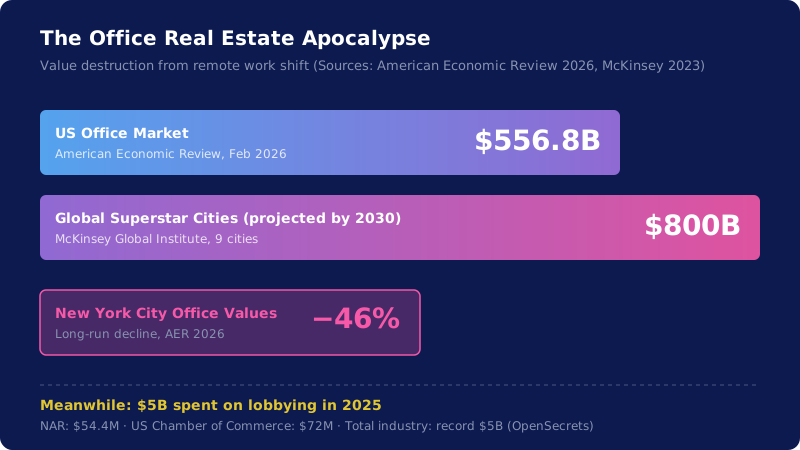
The National Association of Realtors spent $54.4 million on lobbying in 2025 alone, according to OpenSecrets data. The US Chamber of Commerce topped $72 million. Lobbying firms collectively took in a record $5 billion in 2025.
When Jamie Dimon of JPMorgan Chase argues passionately for full-time office attendance, it is worth remembering that JPMorgan is one of the largest commercial real estate lenders in the world. Even major property owners like Brookfield and PIMCO have begun walking away from office investments, handing buildings back to banks rather than refinancing. The people closest to the numbers are voting with their feet, even as they lobby publicly for everyone else to come back.
Stanford economist Nick Bloom posted on X:"WFH levels have become 'flat as a pancake.' Return to the Office is dead."His team's data from March 2025 found that the headline-grabbing mandates"will barely move the needle on WFH."
This is an old guard protecting a revenue stream from property, driving a lot of the hysteria. Once you understand that, the RTO narrative makes perfect sense — not as a productivity argument, but as a financial one.
What the Research Actually Says
Bloom's landmark study, published in Nature in June 2024, examined over 1,600 workers at Trip.com. Employees who worked from home two days a week were just as productive and just as likely to be promoted as their fully office-based peers. Resignations fell by 33%.
Research from the Bank of England found that for each extra day a firm's average employee works remotely, productivity is around £15,000 higher. Gartner's research found that RTO mandates had no effect on employee performance but significantly reduced intent to stay. The people most likely to leave? High performers, women, and millennials.
Only 44% of American workers would comply with a full onsite mandate. The rest said they would quit or begin looking. That is not a workforce rejecting accountability. It is a workforce rejecting bad management disguised as location policy.
The Hybrid Trap
Hybrid, as commonly implemented, often creates the worst of both worlds.
The problem is communication asymmetry. When a team is split between office and remote, two tiers emerge. The people in the room get the sidebar conversation, the whiteboard sketch, the quick decision over coffee. The people dialling in get a laggy video feed and the feeling of being second-class. Remote-first companies like GitLab and Automattic understood this years ago: if one person is remote, everyone is remote.
The other uncomfortable truth about hybrid mandates is what they are often designed to prevent: employees holding multiple jobs. But mandating three office days is a blunt, expensive response to a problem that is about delivery, not location. If someone is meeting their targets, does it matter? If they are not meeting their targets, the problem is the same whether they are moonlighting or scrolling social media at their desk.
The employee who "plays the game" — who clocks in, clocks out, does the minimum, and makes it sound like a maximum — has existed in every office in every era. Remote work did not create these people. It simply made them harder to camouflage. AI will make their lack of output visible in a way that office attendance never did. The people who should worry are not the remote workers. They are the performative presentees who have been coasting on visibility for years.
The "It Harms Younger Workers" Lie
One of the most persistent arguments for RTO is that remote work harms younger workers. This is wrong, and it is patronising.
A job is a job. It is not a family, a friend group, or a kumbaya hippie drum circle where we participate in activities like company laughter yoga in a vain, deluded attempt to make us more productive. Ronald Purser, Professor of Management at San Francisco State University, captured this perfectly in his bookMcMindfulness documenting how corporations co-opt mindfulness and wellbeing as techniques for social control and self-pacification — a shard of false caring that dresses up systemic management failures as individual wellness problems. The corporate pantomime of "culture" — the forced fun, the team-building exercises, the wellbeing workshops that exist to make HR feel good while changing nothing structural — is not a substitute for purpose, clear direction, and meaningful work.
People at all levels need purpose in what they do. Not a pantomime reminiscent of pre-school. Well-versed communications and clear directions help people at all levels function as part of the team. Foster a culture of helping each other out. Make it acceptable to ask and answer questions. Pair junior developers with senior ones. Document your systems properly. Remote onboarding satisfaction rates have reached 87%,surpassingtraditional in-office programmes at 82% (BambooHR). The idea that you need an office to bring someone up to speed is a failure of process, not a failure of location.
The "work friends" argument falls apart under scrutiny. A Glassdoor poll found that 53% of workers actively avoid making close connections with colleagues. Fewer than 25% said they had stayed in a job because of a work friendship. Change a job and your "friends" change. That is not a social network. It is a coincidence of proximity.
Here is what actually helps younger workers: letting them stay where they already are. By letting young people remain in their communities, they keep youth and vibrancy in those areas. They are surrounded by their actual support network — real friends, family, the people who knew them before they had a job title. That is worth infinitely more than an office "culture" that evaporates the moment they hand in their notice.
Eat Your Own Dog Food: Live Where Your Users Live
There is a practical argument for remote work that almost nobody is making, and it is one of the strongest: remote workers live in the communities that use the services they build.
In software, "dogfooding" — using your own products — has been a foundational principle of good product development since Microsoft coined the term in 1988. Remote work extends this from product to context. When your team is distributed across real communities, they encounter the friction points and edge cases that only become visible when you are embedded in the real world rather than sealed in a glass tower in a business district.
Consider banking. The US has lost over 15,000 net bank branches since their peak. Digital banking usage has surged to 89% of adults. Only 18% of consumers prefer visiting a branch. Certain population segments are aging out of branch banking entirely, and we are reaching the point of a 100% tech-native population. Having staff remote means they will need to use the very digital services they build. No greater method exists to drive improvement than using it yourself.
We have seen this first-hand. Music Bingo Live, a real-time entertainment platform we built, was developed working with remote partners. DJs are running games across Europe and feeding back constantly, enabling a product that has been built for and tested on a much wider population than any single office could represent. Had this been done in a traditional office environment, we would have had location biases — working more closely with people we could physically meet, gravitating toward their preferences and assumptions. The delivered product would have had those biases embedded in it. Instead, because the team and the users are distributed, the product reflects a genuinely diverse set of real-world conditions. That is not an accident. It is a direct consequence of remote work.
The company benefits because its people are embedded in the actual communities consuming its goods and services. That is not a bug of remote work. It is a feature.
The Companies That Cannot Make It Work Are the Problem
The companies issuing the loudest mandates are companies with leadership problems masquerading as location problems. BambooHR found a quarter of executives admitted hoping RTO would trigger voluntary turnover — a form of stealth layoff. That is not leadership. It is cowardice dressed up as policy.
We are building teams, not families. And these teams are likely to get much smaller and more focused. WFH is not the issue it is being billed as. The commercial real estate firm JLL found that a new workplace archetype has emerged: the"empowered non-complier"— a high-value employee who simply ignores office attendance rules because their performance speaks for itself. This is not dysfunction. It is the market correcting for bad policy.
AI, the Factory-Style Fallacy, and the Rise of the Lean Company
Everything discussed so far is about to be amplified by artificial intelligence. And it is here that the return-to-office argument collapses entirely.
Mark Dixon, CEO of IWG, put it directly in Fortune in February 2026. Bosses who force five-day mandates are defaulting to a "factory-style approach" from the era of typists and time clocks."Forget about where people are working. Most companies will go by the wayside if they don't embrace AI."People, not real estate, are a company's most expensive asset."You manage by outputs. You manage by activity. You don't manage by walking."
Brian O'Kelley, who sold AppNexus for $1.6 billion, went further:"If you build a culture that's asynchronous and remote, you're building a culture for AI to thrive. If you're building an office culture, you are actually not building an AI-first ecosystem."
The skills that make distributed teams successful — clear written communication, outcome-based measurement, asynchronous workflows, documented processes — are precisely the skills that make AI integration effective. Companies clinging to presenteeism are actively undermining their ability to compete in an AI-transformed economy.
This is not theoretical. In February 2026, Baker McKenzie — a $3.4 billion global law firm with 15,000 employees across 45 countries — announced it was cutting dozens of roles at its Belfast back-office centre, explicitly citing AI and operational efficiencies. This is the same operation that arrived in 2014 with £1.28 million in Invest NI support and a promise of 236 jobs. It grew to 500 people. Now AI is shrinking it. The lesson is not that Belfast did anything wrong. The lesson is that centralised back-office operations — the very model that filled city-centre office buildings — are exactly the kind of work AI displaces first. The companies that survive this will be distributed, lean, and outcome-focused. The ones clinging to headcount in glass towers will not.
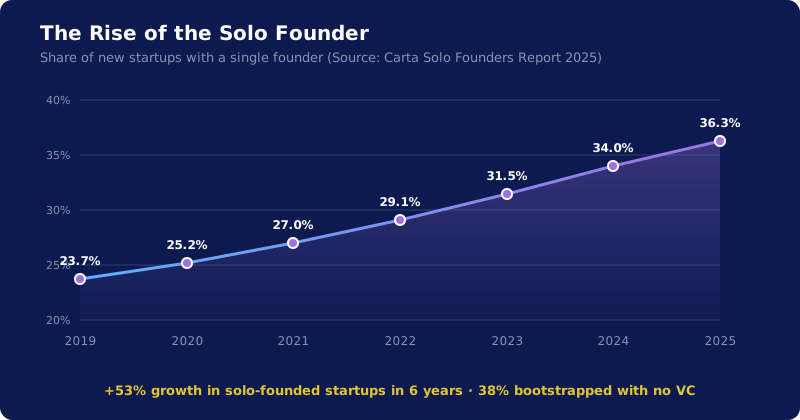
According to the Carta Solo Founders Report 2025, the share of new startups with a solo founder rose from 23.7% in 2019 to 36.3% in 2025. Solo-founded companies like Midjourney, Polymarket, and Vercel are category-defining. These companies are remote by default. There is no office to return to. The next generation of high-growth companies may never need office space in the first place.
The Green Dividend and Regional Equality
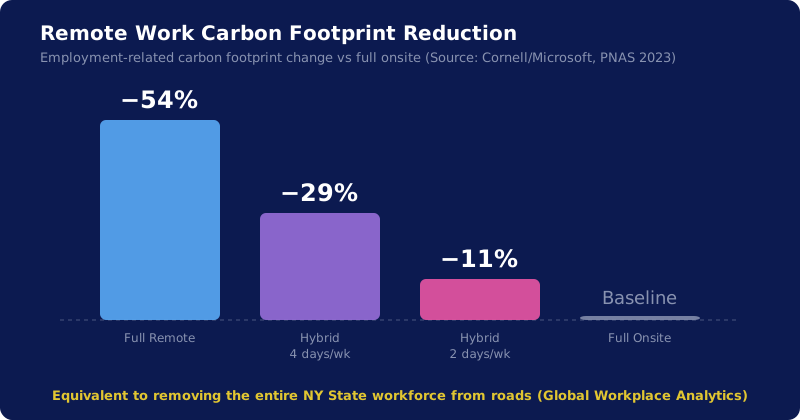
A Cornell/Microsoft study in PNAS found that full remote work reduces an individual's carbon footprint by up to 54%. A 1% increase in remote work share results in a 1.8% reduction in urban transport emissions. For any government serious about climate targets, distributed work is one of the simplest levers available.
The economic geography argument is equally compelling. When a software engineer in Derry works for a London fintech firm, the economic value stays local. Research from the Economics Observatory estimates £3 billion in spending reallocation from city centres to residential neighbourhoods. A 2025 Regional Studies paper found remote workers are significantly more likely to move to rural areas, bringing skills and economic diversity to communities that have suffered decades of talent exodus.
The UK Government's own Unleashing Rural Opportunity report acknowledged:"in today's world you can run a financial services company or an architectural practice from the top of a remote valley just as well as you can in a town or city."
This is the levelling-up that no amount of government spending can buy. It is organic, market-driven redistribution of economic opportunity.
The Path Forward
The return-to-office narrative is driven by commercial real estate interests, executives who confuse control with leadership, and a media ecosystem that rewards contrarian hot takes over peer-reviewed research.
The evidence — from Stanford, from Nature, from the American Economic Review, from Cornell, from Pittsburgh, from Gartner, from the Bank of England — tells a consistent story: remote work, when properly managed, delivers equal or superior productivity, dramatically better retention, significant environmental benefits, and the potential to reshape regional economies for the better.
The answer is remote-first: default to distributed, document everything, measure outcomes, bring people together intentionally when there is genuine value — not as a standing mandate born of managerial anxiety.
AI is accelerating this beyond return. Companies clinging to five-day mandates are not preserving culture. They are preserving the property values of their landlords while building organisations structurally incapable of thriving in an AI-first economy.
The buildings can be repurposed. The commutes can be eliminated. The talent can be unlocked wherever it lives. The only thing standing in the way is the vested interest of those who profit from the old model, and the inertia of leaders too timid to manage by outcomes rather than by attendance.
Key Sources
- Dixon, M. (2026) Fortune — "Factory-style approach" critique
- Irishoak (2026) — Four years of remote work research
- Bloom, N. et al. (2024) Nature — Trip.com hybrid study
- Gupta et al. (2026) American Economic Review — "Office Real Estate Apocalypse"
- University of Pittsburgh (2024) — RTO mandates and S&P 500
- Cornell/Microsoft (2023) PNAS — Climate mitigation of teleworking
- Purser, R. (2019)McMindfulness: How Mindfulness Became the New Capitalist Spirituality.Repeater Books.
- Carta (2025) — Solo Founders Report
- Gartner (2024) — RTO mandates and talent risk
- Elliott, B. (2025) MIT Sloan — "How to Lose Your Best Performers"
- Bloom & Davis (2025) Stanford — WFH is here to stay
- OpenSecrets (2026) — Record $5B lobbying spend
- Economics Observatory (2022) — Regional economies and remote work
- Clarke, K. (2025) Regional Studies — UK remote work and rural migration
- UK Government (2023) — Unleashing Rural Opportunity
- CNBC (2026) — Office real estate stocks tumble as AI disruption casualties grow