A VS Code extension that renders your codebase's identifiers as a word cloud — so you can see, at a glance, whether your ubiquitous language actually made it into the code.
Why Lexicon?
Open any codebase and read the type names, the method names, the variables. If what you see is
OrderManager, PaymentHandler, DataProcessor, UserUtils —
a wall of Manager, Handler, Service, Data — then your
code isn't speaking your domain. It's speaking plumbing. The ubiquitous language your team argues
about in the standup never made it into the source.
Lexicon makes that visible.
Reading the cloud
Same car-rental codebase, two different states. On the left, the loudest words are the domain —
rental, reservation, vehicle, booking, fleet.
On the right, mechanism has taken over — manager, service, handler,
data — and the actual domain has shrunk to the bottom row.
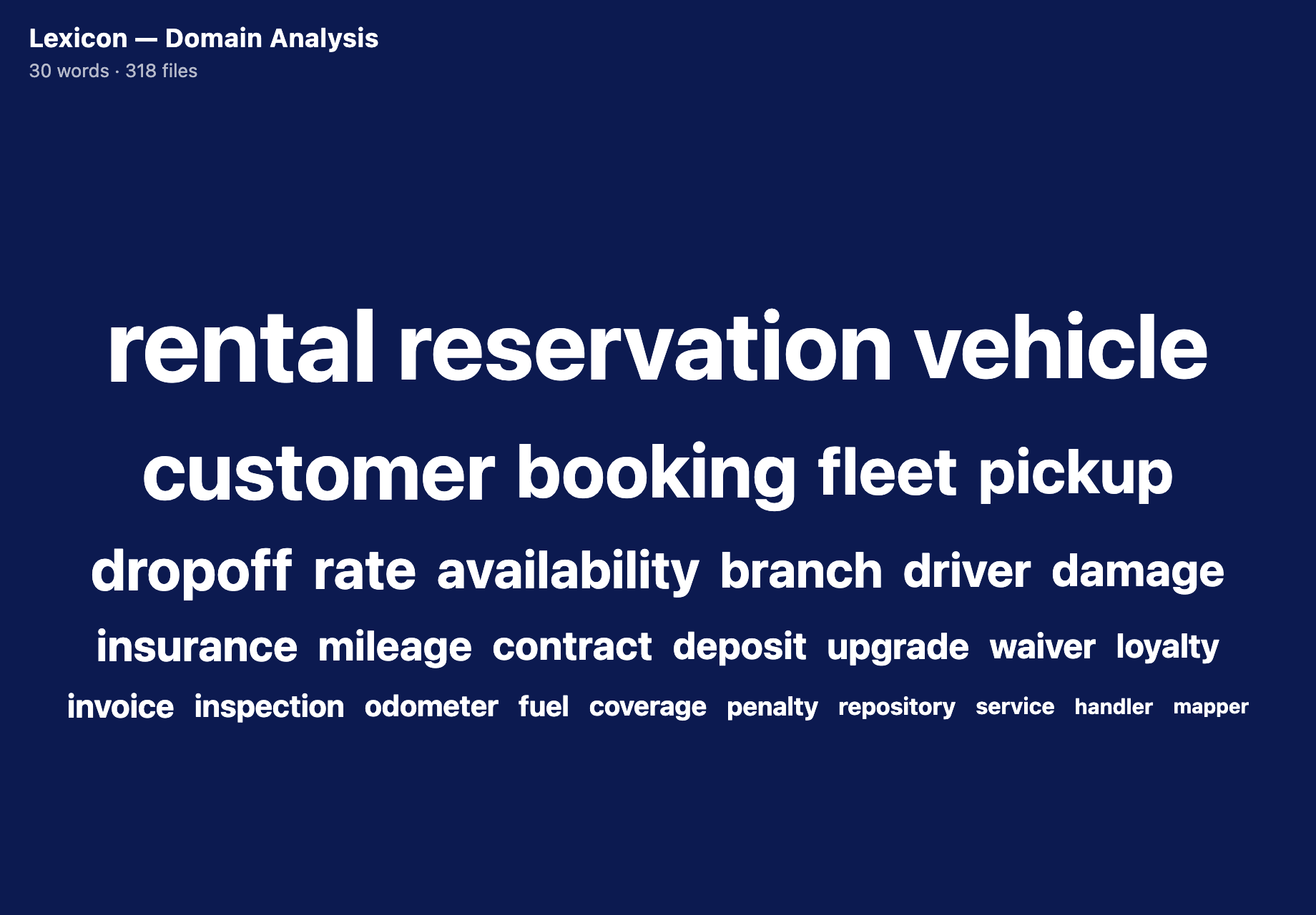
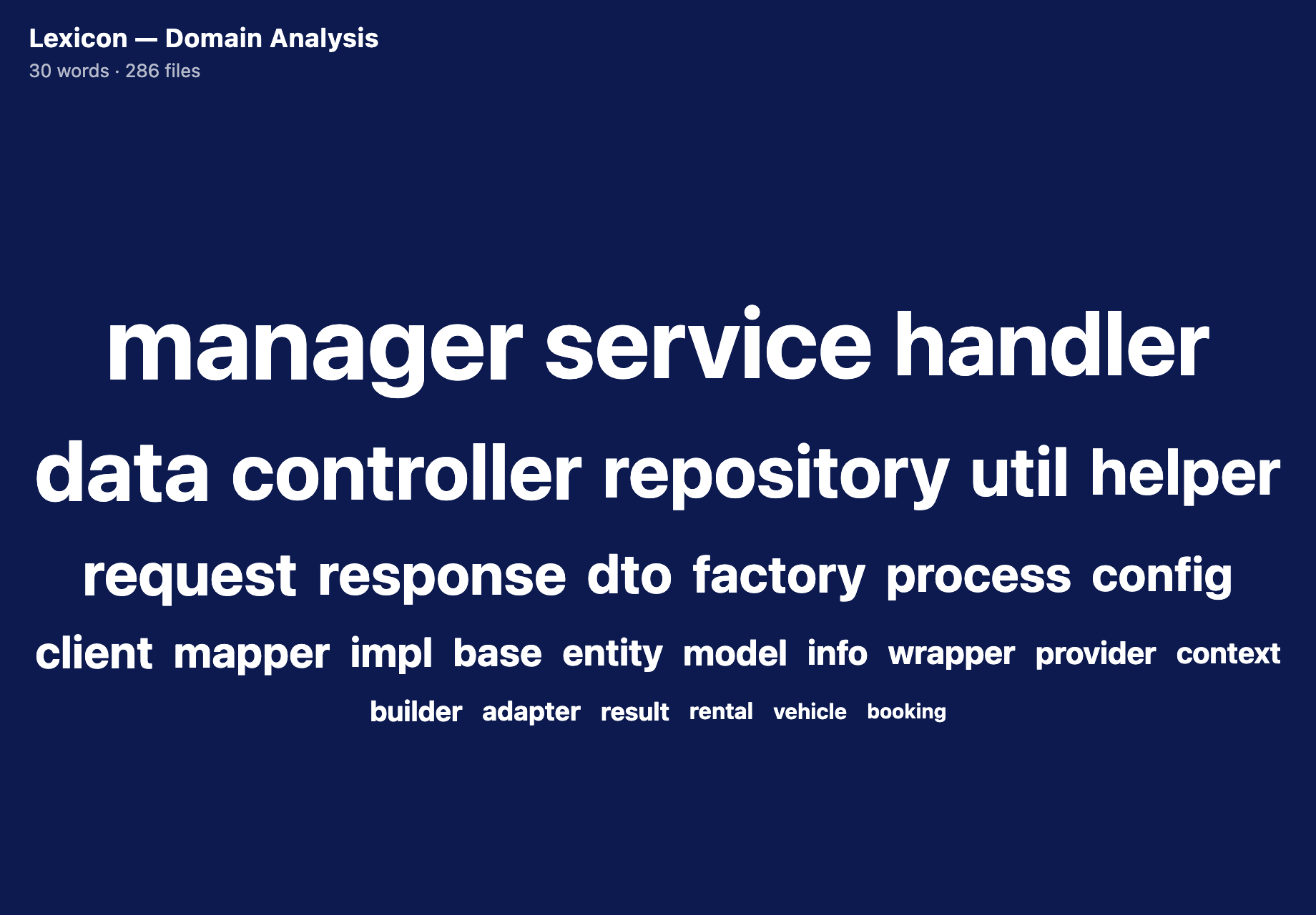
Every word is the same colour. The signal is size — the bigger the word, the more your
code says it. There's no built-in verdict on which words are "good" or "bad", because that's
domain-specific: data is plumbing in a payments service and the whole point in an analytics
product; model is a smell in one codebase and the core noun in an ML one. Lexicon won't pretend
to know which is which — it shows you what your code actually says and trusts you to read it.
Identifier-aware
Extracts every identifier and splits it on camelCase, PascalCase, and snake_case boundaries, then strips language noise like err, ctx, string, and return.
Size is the signal
The biggest words are the words your code says most. That's your real, de-facto ubiquitous language — for better or worse.
Tunable, not opinionated
Drop a .lexiconignore in your workspace root to suppress genuine background hum — and the subtitle reports how many terms you ignored, so a tidy cloud is never silently curated.
Fully local
No server, no subprocess, no network calls, no telemetry. It runs entirely on your machine and nothing leaves it.
Running it
- Open the codebase you want to analyse as a workspace folder.
- Command Palette (
Cmd/Ctrl+Shift+P) → Lexicon: Analyse Codebase. - Read the cloud.
Runs entirely locally. No server, no subprocess, no network calls, no telemetry. Nothing leaves your machine.
Tuning what's counted
Lexicon strips only language grammar by default — keywords, primitive types, and literals
(return, func, class, string, static). It does
not pre-decide that http, fmt, println or generic verbs are
noise. Whether those are plumbing or signal is a call only your codebase can make, so the tool surfaces them
and lets you decide.
To suppress terms for a specific project, drop a .lexiconignore file in the workspace root — one term per line, # for comments:
# .lexiconignore — terms this codebase treats as plumbing
http
fmt
errorf
slog
println
base64
# generic CRUD verbs, if they're drowning the domain words
get
set
fetch
Terms match the lowercased, split words (so http also strips it out of httpClient).
A word of caution: a clean-looking cloud you achieved by ignoring everything isn't a clean codebase. Reach for
.lexiconignore to remove genuine background hum, not to hide the finding.
Supported languages
Install
Install from the Visual Studio Marketplace, or search for Lexicon in the Extensions view inside VS Code:
Requires Visual Studio Code 1.85 or later. Free and MIT-licensed.
Learn More
For full documentation and source, see the GitHub repository.